MA Programmes in East Asian Art History (KGOA MA)
Table of contents
Introduction
At MA level, East Asian Art History is offered as a major (90 ECTS) and as a minor (30 ECTS).
The MA Programme in East Asian Art History at the University of Zurich offers a rigorous and globally oriented programme for students seeking advanced training in the visual cultures of China, Japan, and Korea. Combining close engagement with artworks and objects with critical theory and historical analysis, the programme equips students with the intellectual tools needed to understand East Asian art in local, regional, and global contexts.
Students develop strong skills in object-based research, historiography, and visual analysis, while engaging with key debates in art history, cultural history, and visual studies. Teaching is research-led and seminar-based, encouraging independent thinking, discussion, and the development of individual research profiles.
Courses and Areas of Study
The curriculum spans a broad chronological and thematic range, from premodern art and material culture to modern and contemporary practices. Recent courses include seminars like Space, Place and Mobility in East Asian Art: Theft or Artistic Prerogative? Transcultural Appropriation (Machotka, FS25) and Species, Art and Power: Animals in East Asian Art (Machotka, HS25) and lectures like Before and After Nature: Ecocritical Perspectives on Japanese Art (Machotka, FS25) and Inside the Art World: Collecting, Curating, and Cultural Diplomacy in the Chinese Cultural Sphere (Sigg, HS25).
The programme benefits from an international teaching environment, with visiting professors and guest lecturers from leading museums and academic institutions contributing regularly to the curriculum.
Excursions and Experiential Learning
Study trips and excursions form an integral part of the MA experience. Students gain first-hand access to major collections, exhibitions, and museum practices in Switzerland and beyond, fostering direct engagement with artworks and curatorial contexts. These encounters complement academic study and prepare students for professional work in museums and cultural institutions.
The Ishibashi Foundation Graduate Programme
A distinctive feature of the MA landscape is the Ishibashi Foundation Graduate Programme in Japanese Art History and Multimodal Heritage Curationhosted by the Chair of East Asian Art History. This asmission-based programme offers advanced MA and doctoral students the opportunity to combine academic research with curatorial training, digital heritage methods, and international collaboration. The programme includes intensive workshops, work with museum partners, and engagement with leading scholars and practitioners in the field.
Career Pathways
Graduates of the MA in East Asian Art History pursue careers in:
- academic research and doctoral study
- museums and curatorial practice
- cultural institutions and foundations
- galleries, publishing, and cultural diplomacy
The programme offers an intellectually demanding and internationally connected environment, providing students with a foundation for both academic and professional futures in the global field of art history.
Standard Curriculum MA KGOA 90
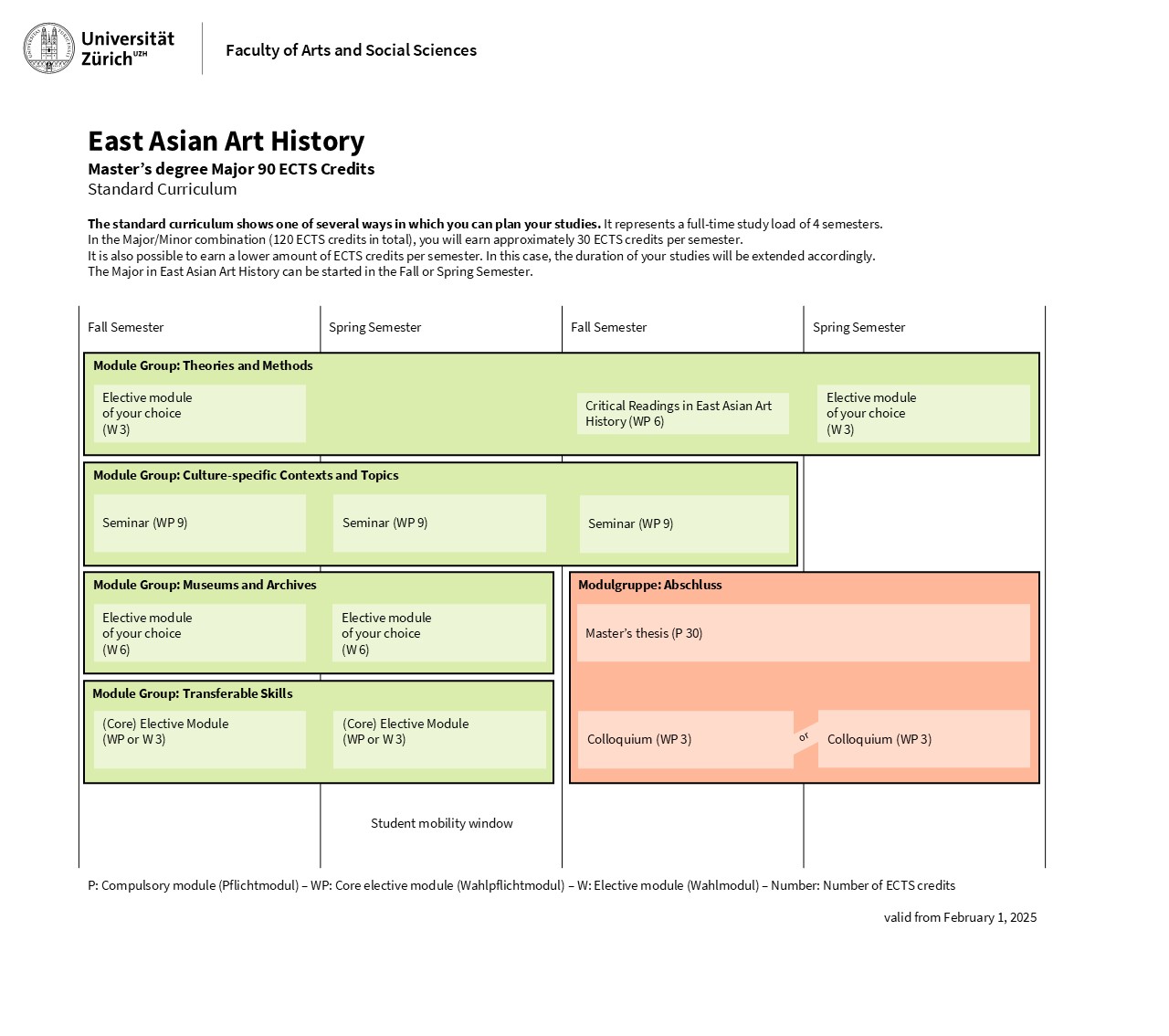
Standard Curriculum MA KGOA 30

Course Booking
For information on booking and canceling courses, see: https://www.students.uzh.ch/en/studyadmin/booking.htmlhttps://www.phil.uzh.ch/en/studies/studyessentials/assessments.html
The page Wichtige Dokumente [Important Documents] (in German) at the Department of Art History provides further information on planning your studies. Also refer toDocuments in the MA Program (in German) for documents relevant to the Bachelor's study programs. AGlossary is available for your orientation. In theGeneral Guidelines for Studying at the Faculty of Arts and Social Sciences (in German) you will find information for your studies that is relevant for students of all study programs.
Module: "Critical Readings in East Asian Art History"
In the module “Critical Readings in East Asian Art History” (short: Critical Readings), students review research literature in self-study and discuss the readings in an oral examination. It is recommended that students complete the module in the semester preceding their Master's thesis. This helps review some of the research literature for their Master's thesis as a part of the individually selected exam texts.
The required readings for the module are divided into two parts:
- "Thematic and Theoretical Focal Points", a set list of texts addressing important themes and concepts in East Asian art history. These texts build the foundation for advanced studies in various temporal, geographical, and thematic dimensions of the subject. (Download link for the reading list PDF can be found in the box below).
- "Text Selection on the Research Focus", two individually selected texts that are central to each student’s own research. Students must register their choice of two individually selected texts on a separate form and will be assessed on the content of these texts as well as the texts in the specified bibliography (i.e., "Thematic and Theoretical Focus").
The assigned texts will be made available on OLAT (in the materials folder for the campus course for the module).
Registration for the module is done through the regular module booking process and is subject to the usual booking and cancellation deadlines. To fulfill the assessment requirement (oral examination), (a) the completed form "Registration of Literature Selection for the Module 'Topical Readings'" (link to download in the box below) and (b) the two selected texts must be submitted as PDFs by email to the KGOA assistants (kgoa@khist.uzh.ch). The submission deadline for the fall and spring semesters is the end of the second week of lectures. Admission to the examination is not possible without a valid form.
N.B. The individually selectable texts should be approved by Prof. Dr. Ewa Machotka before submitting the form. Please contact Prof. Machotka directly ewa.machotka@khist.uzh.ch